Summer may be BBQ season, but it’s also the time when people travel long distances in planes, trains, and automobiles. For us in vein healthcare, that means increased risks of Deep Vein Thombosis, or DVT.
The deep vein system carries about 80% of blood from the feet back up to the heart. Deep veins are located under the muscle and connective tissue layers in the legs. A blood clot in a deep vein can be dangerous because the high pressure in the system could cause the clot to break free from the vein wall and enter the blood stream. The DVT could then travel up through the legs into another part of the body such as the lungs, where it would become a pulmonary embolism (PE).
DVT or PE symptoms are often misinterpreted as something less serious. A blood clot in the leg may feel like a “charley horse,” shin splints, or a twisted ankle. Symptoms from PE are often attributed to a pulled muscle in the chest, costochondritis (inflammation of the joint between ribs and breast bone), asthma, or a “touch of pneumonia.”
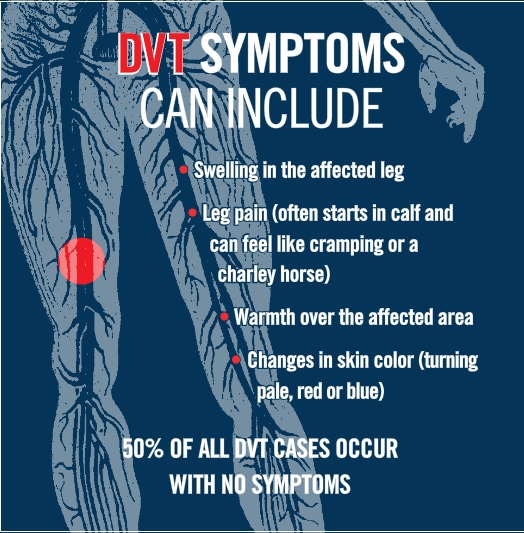
So what are some of the signs to look for? For DVT, the leg may be warm to the touch; swelling in the leg (can also occur in the arm); leg (or arm) pain or tenderness; reddish or bluish skin discoloration.
For PE, be aware of a sudden shortness of breath; sharp, stabbing chest pain (may get worse with deep breath); rapid heart rate or breathing; feeling lightheaded or fainting; unexplained coughing, sometimes with bloody mucus.
In half of DVT and PE cases, no symptoms present at all—but both conditions are medical emergencies. Any of these symptoms should be regarded as a DVT or PE until proven otherwise, especially if someone is in a risk category (including whether there is a history of blood clots in your family).
Awareness is key-- and so is prevention. When traveling long distances, stay well hydrated, stretch legs your legs and pump your feet periodically, avoid or moderate alcohol and caffeine, and consider wearing graduated compression stockings on your trip.
To find out more about DVT and other vein issues, contact us at the Vein Healthcare Center. We will evaluate your vein health — including spider veins, varicose veins, and leg ulcers.
Showing posts with label dvt travel. Show all posts
Thursday, June 14, 2018
Tuesday, October 27, 2015
Athletes and blood clots
In our last post we told you about World Thrombosis Day, and before that we talked
about the effect of athletic activity on veins.
Now we take a look at the topic of athletes and deep vein thrombosis, or DVT.
Deep veins are located under the
muscle and connective tissue layers in the legs. A blood clot in a deep
vein—known as deep vein
thrombosis, or DVT—can be dangerous because the high pressure in the system
could cause the clot to break free from the vein wall and enter the blood
stream. The DVT could then travel up through the legs into another part of the
body such as the lungs, where it would become a pulmonary
embolism (PE).
DVT or PE symptoms are often
misinterpreted as something less serious. A blood clot in the leg may feel like
a “Charlie horse,” shin splints, or a twisted ankle. Symptoms from PE are often
attributed to a pulled muscle in the chest, asthma, or a “touch of pneumonia.”
In half of DVT and PE cases, no symptoms
present at all—but both conditions are medical emergencies. Any of these
symptoms should be regarded as a DVT or PE until proven otherwise, especially
if someone is in a risk category (including whether there is a history of blood
clots in your family).
Remember, being active and fit does not prevent someone
from developing blood clots. Athletes, coaches, and trainers should be aware of
these risk factors:
·
Traveling long distances to and from a sports
competition
·
Dehydration (during and after a strenuous sporting event)
·
Significant trauma
·
Immobilization (in a brace or cast)
·
Bone fracture or major surgery
·
Family history of DVT or PE
·
Presence of an inherited or acquired clotting disorder
Treatment of blood clots depends on many variables, including
your health background and the extent and location of the clot. And, of course,
prevention is the best medicine. Go to our latest issue of Vein Health News to learn more.
Labels:
athletes
,
blood clot in leg
,
blood clots
,
deep vein thrombosis
,
dvt
,
dvt awareness
,
dvt risk factors
,
dvt symptoms
,
dvt travel
,
pulmonary embolism
,
world thrombosis day
Tuesday, August 19, 2014
The calf pump
Is “the calf pump” a new dance all the kids are doing? No, it
has something to do with veins, of course! Namely, making sure the circulation
in your legs is working properly.
As summer draws to a close, many people are returning from
vacation, driving in their cars, or hopping a long flight home. In order to
prevent deep vein thrombosis (known as DVT), try the foot pump, in the car or
on the plane.
It’s a simple toe-tap
exercise: tap your feet for a minute or two, going back and forth between heels
and toes. This squeezes the deep veins in the legs and forces the blood to
circulate through the leg. It also feels good after sitting for a long period
of time. Do the foot pump (on each foot) every half-hour or so.
Also, don’t forget to
stay hydrated, preferably with water. And try to take a brief walk in the airplane aisles (or at the
rest stop) occasionally to keep the blood flowing.
Labels:
blog clot in leg
,
blood clot in leg
,
blood clots
,
deep vein thrombosis
,
dvt
,
dvt awareness
,
dvt travel
,
economy class syndrome
,
vein health
,
vein treatment maine
,
walking
Tuesday, March 18, 2014
How compression can help-- and help prevent-- DVT
In addition to managing both acute and chronic DVT, compression can be a tool for prevention. When there are risk factors for DVT, such as long distance car or plane travel, immobility, or pregnancy, wearing compression stockings can reduce its occurrence.
What do we mean by compression? Graduated compression stockings provide a gradient of pressure against the leg. The pressure is highest at the foot and ankle and gradually decreases as the garment rises up the leg. This pressure gradient makes it easier for the body to pump blood up towards the heart (the normal direction) and more difficult for gravity to pull blood downward.
Compression stockings require a prescription and can be purchased at many pharmacies, most major medical supply stores, and specialty stores. Your doctor can tell you if you need knee-highs, thigh-highs, or a “pantyhose” style.
These days, compression stockings are fashionable, comfortable, and come in a wide variety of styles and colors. Though modern compression stockings usually look like socks or tights, putting them on can be a challenge.
It’s important to note that “TED hose”— the “anti-embolic" stockings that are often worn after surgery to help prevent DVT— are not the same as graduated compression stockings. TED hose work well for patients who are bed bound, but won’t offer much benefit to patients who are up and walking.
There are many benefits to using graduated compression therapy besides reduced risk factors for DVT, but be sure to consult your physician first. Compression is not appropriate for all patients and can actually have adverse affects on patients with peripheral arterial disease.
To learn more about DVT, read our previous posts.
Labels:
blood clot in leg
,
blood clots
,
compression
,
deep vein thrombosis
,
dvt
,
dvt awareness
,
dvt awareness month
,
dvt risk factors
,
dvt symptoms
,
dvt travel
,
graduated compression
,
treatment dvt
Tuesday, March 11, 2014
DVT: symptoms to look for and step toward prevention
Last week we described what DVT is and who is at the greatest risk for getting one. Now let's look at the most common symptoms to watch out for.
In most cases, the affected area-- usually in the leg-- will be painful, swollen or tender, with a redness or discoloration of the skin. Even a muscle cramp that feels especially sharp and painful can be an indication of DVT. DVT is a medical emergency, so any symptoms should be regarded as a DVT until proven otherwise, especially if someone is in a risk category.
It's important to note that about half of the time, DVT has no symptoms at all.
The good news is that DVT can be prevented! And because DVT can occur with little or no warning, the best action to take is prevention. Without preventive treatment, for example, up to 60 percent of patients who undergo total hip replacement surgery may develop DVT.
The Centers for Disease Control and Prevention (CDC) recommends the following tips for DVT prevention:
- Understand your level of risk, and talk to your doctor about DVT, especially if you're in a high-risk group.
- Maintain a healthy weight, eat a healthy diet and don’t smoke.
- Exercise regularly.
- Move around as soon as possible after surgery, illness or injury. Even passive movement helps.
- When traveling or sitting for more than four hours get up and walk around every few hours and exercise legs while sitting.
- Drink plenty of water and avoid alcohol or caffeine.
To find out more about DVT symptoms and prevention, go to www.stoptheclot.org.
Labels:
blood clot in leg
,
blood clots
,
deep vein thrombosis
,
dvt
,
dvt awareness
,
dvt awareness month
,
dvt symptoms
,
dvt travel
,
economy class syndrome
,
venous thromboembolism
,
vte
Tuesday, March 4, 2014
March is DVT Awareness Month
More than 1,240 Mainers succumb to DVT- (deep vein thrombosis) and PE-related (pulmonary embolism) deaths every year, according to the Mayo Clinic. And this estimate is likely on the low side.
In fact, the annual mortality rate of blood clots is greater than yearly deaths in the U.S. from breast cancer, AIDS and automobile accidents combined. Though most people know about these issues, DVT is still under-recognized.
March is DVT and Blood Clot Awareness Month. It's a chance for the medical community to educate the public about a medical condition that affects approximately two million Americans annually.
All month long we'll be taking a closer look at DVT: what it is, who is at risk, and what you can do to prevent ever getting one.
So what is DVT? Deep vein thrombosis (DVT) is a blood clot in the deep vein system. The danger is that the clot could break free from the vein wall and enter into the blood stream. The clot could then travel to the lungs and become a PE (pulmonary embolism), or to the brain and result in a stroke. DVT-related PE is the leading cause of preventable death in U.S. hospitals.
Anyone can get a DVT and at any age. Certain groups, however are at a greater risk of developing a life-threatening blood clot.
- Those with prolonged immobility or no mobility, like patients in the hospital or on bed rest, or long-distance travelers (so-called “economy class syndrome”)
- People with blood-clotting issues, like those with a genetic disorder, or cancer patients undergoing surgical procedures
- Patients with damage to their vein walls because of surgery or injury
- Pregnant women are more susceptible to DVT because of hormonal changes
- Seniors
This is, by no means, a complete list of risks, and it's important to remember that risk factors can be compounded. For example, combining an existing blood clot disorder with immobility can dramatically raise the risk of deep vein thrombosis.
Having risk factors does not mean that you will surely get a DVT-- rather, you should be proactive about prevention.
Take this month to learn more about DVT, take an online risk assessment, and ask your physician if you may be at risk.
Labels:
blood clot in leg
,
blood clots
,
deep vein thrombosis
,
dvt
,
dvt awareness
,
dvt awareness month
,
dvt risk factors
,
dvt travel
,
economy class syndrome
,
treatment dvt
,
venous thromboembolism
,
vte
Wednesday, July 17, 2013
Should You Be Worried About “Economy Class Syndrome”?
Concerns about blood clots as a result of Deep Vein Thrombosis (DVT) increase during summer travel season. Blood clots can be dangerous, even fatal – but they can be prevented.
It’s the height of the summer and for many, July marks the beginning of travel season. It’s the time spent en route to vacation destinations that lead to concerns about “economy class syndrome,” a term used to describe leg symptoms that can occur as a result of long periods of immobility.
These extended periods of immobility can be associated with deep vein thrombosis, or DVT, a blood clot in the deep vein system. DVT can be cause for concern because the clot could break free from the vein wall and enter into the blood stream, traveling to the lungs and become a PE (pulmonary embolism), or to the brain and result in a stroke.
Though a familiar term to many, “economy class syndrome,” is actually a misnomer. DVT can occur in a plane, train or automobile, regardless of what class you’re sitting in. The point is that prolonged immobility can slow down circulation and lead to blood pooling in the legs, which significantly increases the risk of DVT.
Prevent DVT During Summer Travel
If you’re planning to go on a long flight (or road trip, for that matter), you can minimize the risk of DVT. First, stay hydrated. Then, make a point of walking in the aisles (or at the rest stop) occasionally. Finally, periodically do simple toe-tap exercises – that means tapping the feet for a minute or two, going back and forth between heels and toes. This “foot pump” squeezes the deep veins in the legs, forcing the blood to circulate.By increasing mobility and making healthy blood flow a priority while you travel, you can help keep blood clots at bay this summer – and any time of year.
Are you at risk for DVT? Visit the Vein Healthcare Center to learn about the risks and steps toward prevention.
The Centers of Disease Control and Prevention also offers more information about Deep Vein Thrombosis and its symptoms and risk factors.
Labels:
blood clot in leg
,
blood clots
,
deep vein thrombosis
,
dvt
,
dvt risk factors
,
dvt symptoms
,
dvt travel
,
economy class syndrome
,
treatment dvt
Subscribe to:
Posts
(
Atom
)