Showing posts with label dr. cindy asbjornsen. Show all posts

Tuesday, September 1, 2026

Elevate! Elevation Tips to Relieve Vein Disease Symptoms

There are a variety of vein treatments for varicose veins and other venous diseases. In some cases, elevating your legs can alleviate the pain and/or swelling that comes from early-stage vein disease. 

So, what is elevation and how do you do it? Leg elevation means raising the legs above heart level. The ideal position is to lie on a couch with your back on the cushions and feet up on the armrest, so your feet are at a slight angle higher than the heart. Lying down with your legs resting on three or four pillows also works well. 

Here are more tips on how to get the most out of this accessible therapy: 

  • Elevating at intervals throughout the day can encourage blood flow from the legs and decrease the pooling of blood.  
  • Legs should be elevated as often as possible, for as long as 30 minutes or as briefly as three minutes. 
  • The morning is a good time to elevate. 
  • The best time to elevate is after a hot shower, or after standing for a long time. A good way to remember to elevate is to pair it with your meals or snacks. 

A vein specialist can guide patients on the most effective elevation techniques. “For someone with venous disease, elevation is so important that at the Vein Healthcare Center we have recliners and ottomans in the reception area, so patients can elevate while they wait,” said Dr. Asbjornsen.  

To understand how elevation provides relief, here is a brief review of how veins work. Veins carry blood from the legs and arms back to the heart. The blood in the legs travels up against gravity, so when the valves in the veins become damaged, blood “leaks” back into the legs and creates a “pooling” effect. 

Effective treatment begins with a thorough evaluation from a qualified phlebologist who will look for the source of the problem: the leaky vein valve or valves. Once that is identified, the physician can recommend the next best options for treatment. 

Elevation is a simple, yet powerful, tool that can help improve blood circulation in the veins and provide some relief to venous symptoms. 

To learn more about vein treatments, contact us at the Vein Healthcare Center today to schedule an evaluation!

Sunday, March 1, 2026

March is Blood Clot Awareness Month


Blood clots affect up to 900,000 Americans each year — and of that number, up to 100,000 lives are lost. Despite their prevalence, blood clots are frequently missed or diagnosed too late, in part because symptoms can be subtle, unexpected, or mistaken for other conditions. Increasing awareness helps people recognize warning signs sooner, ask the right questions, and take timely action — all of which can save lives.

Each March, the National Blood Clot Alliance observes Blood Clot Awareness Month to raise awareness about blood clots. Their theme this year is Strong Enough to Ask – A Campaign to Stop the Clot, which reframes strength as self-advocacy. The campaign focuses recognizing when something doesn’t feel right, trusting your instincts, and speaking up before a blood clot becomes life-threatening.

What is a blood clot?
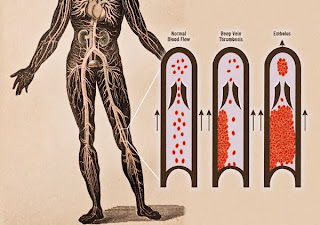
A blood clot is a gel-like mass of blood that forms in a vein or artery. While clots play an important role in stopping bleeding after injury, they can also form when they aren’t needed. These abnormal clots can block blood flow and lead to serious conditions such as deep vein thrombosis (DVT) and pulmonary embolism (PE).

Who can get a blood clot?
Blood clots can affect anyone, regardless of age, ethnicity, race, gender, or activity level. However, certain health conditions, life events, and situations can increase risk. Knowing your personal risk factors can help you recognize symptoms sooner and speak up when something doesn’t feel right.

Other risks, including a family history of blood clots, people 55 or older, injury or trauma, and estrogen-based contraception or hormone therapy. Long-term diseases, such as heart conditions or diabetes are also risk factors. You can take a risk assessment here.

Signs and symptoms
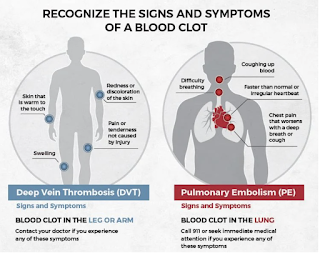
Common signs and symptoms of a DVT include swelling, usually in one leg (or arm); pain or tenderness not caused by injury; reddish or bluish skin discoloration; and/or skin that is warm to the touch. Contact your doctor as soon as possible if you have any of these DVT symptoms.


Common signs and symptoms of a PE include shortness of breath; chest pain that’s sharp; faster than normal or irregular heartbeat; unexplained cough, sometimes with blood; and/or low blood pressure or lightheadedness. Call 9-1-1 immediately if you experience any of these PE symptoms.

Click here for more signs and symptoms of blood clots in greater detail.

Learn more about blood clots
To learn more about blood clots -- including how to spot and prevent them -- go to the StoptheClot website. If you have any questions about DVT, you're welcome to contact the Vein Healthcare Center.


Wednesday, January 21, 2026

3 reasons why winter is a great time for vein treatment

Diagnosing and treating varicose veins (and other forms of venous disease like spider veins and leg ulcers) is a good idea any time of year. Winter, however, is an excellent time for vein treatment. 

Here are just a few reasons why:

1. Cozy Compression

With a vein procedure such as ablation, you will be required to wear medical-grade compression stockings any time you are on your feet for the first two weeks following treatment. (After sclerotherapy, you should wear compression 7-14 days when you are on your feet.) The good news is that post-procedure compression stockings will keep you warm while you recover – and it’s much more comfortable with a winter wardrobe.

2. Less Swelling, More Comfort

Heat causes blood vessels to expand, or vasodilate, which can increase swelling and discomfort in legs that are prone to varicose veins. The cold weather naturally constricts blood vessels, which can potentially reduce post-procedure swelling and makes recovery feel easier than in the summer heat.

3. Ready for Summer 

Recovery from vein treatments take time. Patients can expect some amount of bruising, swelling, and tenderness, although post-procedure discomfort is highly variable from person to person. While some patients may experience discomfort, some may feel none at all. It takes time for legs to recover from vein treatment. If you get started in the winter months, you’ll be more ready for shorts in the summer.

If you’re concerned about your vein health and want to schedule an appointment this winter, feel free to contact us at the Vein Healthcare Center. Our goals are to learn about your condition, help you understand how your vein health affects your overall health, and provide you with treatment options. We make taking the first step simple, comfortable, and stress-free!


Monday, November 6, 2023

Meet Dr. V!

Dr. Cindy Asbjornsen and the staff are proud to welcome Dr. Satish Vayuvegula to the Vein Healthcare Center team!

Dr. Vayuvegula (pronounced vye-VAY-gla), MD, MS, FAVLS, DABVLM has been a close colleague of Dr. Asbjornsen’s for almost 15 years. He is Board certified in both Phlebology and Emergency Medicine and has 20 years of experience diagnosing and treating venous disease. 

Dr. Vayuvegula earned his medical degree from The Chicago Medical School in 1999 and completed his residency at Emory University School of Medicine and Affiliated Hospitals of Atlanta, Georgia. 

After residency, Dr. Vayuvegula was invited to train in venous techniques. His interest in vein disease began during his residency when he learned that he had varicose vein disease. He underwent a thermal ablation and immediately experienced a dramatic improvement in his quality of life.

Since becoming certified by the American Venous &  Lymphatic Society, Dr. Vayuvegula has performed thousands of thermal ablations and vein procedures. He has been an active member of the American Vein & Lymphatic Society and the American Medical Association since 2005. He became an AVLS Board member in 2018, Secretary in 2020, Treasurer in 2021, and was named President-Elect in 2022 and he most recently was a co-author on two multi-society national guidelines publications on the treatment of venous disorders.

When not helping patients, Dr. Vayuvegula loves spending time with his family and traveling. He also enjoys playing golf, tennis, and pickleball.
 

Thursday, August 18, 2022

Dr. Asbjornsen presents at the 2022 Maine Osteopathic Association conference


Earlier this summer, Dr. Asbjornsen presented a seminar called "Aging & Vein Health" to doctors at the Maine Osteopathic Association's annual conference. There's so much useful information in the presentation, that we wanted to share it more widely!

Here are just a few of the things you'll learn:

  • How vein disease presents differently depending on a person's age
  • There are different categories of older adults in the general term "seniors"
  • Several modern, non-invasive treatments can help decrease the leg pain and discomfort associated with vein disease
  • Get to know more about Dr. Asbjornsen and her passion for vein health

Click here to watch the full video, or visit the Vein Healthcare Center YouTube channel.

Wednesday, March 2, 2022

March is Blood Clot Awareness Month


Have you heard of Deep Vein Thrombosis (DVT) or Pulmonary Embolism (PE)? Maybe you're more familiar with the term blood clots. 

Thousands of lives are lost each year to preventable blood clots, so during Blood Clot Awareness Month -- and throughout the year -- many in the medical community, including Dr. Cindy Asbjornsen, help to spread the word about this common condition. 

Know your risk

The first and most important thing you can do to protect yourself is to learn if you are at risk. 

People being treated for cancer, hospitalized with COVID-19, or getting hip or knee replacements are all at greater risk for developing blood clots. But did you know that even athletes may have increased risk factors too?

Read this risk checklist to learn more.

Signs and symptoms

Common symptoms of a blood clot in the leg or arm (also known as Deep Vein Thrombosis or DVT) include swelling, pain or tenderness (not caused by injury), redness or discoloration of the skin, or skin that is warm to the touch.

Symptoms of a blood clot in the lungs (also known as a Pulmonary Embolism or PE) include difficulty breathing, chest pain that gets worse when you breathe deep or lie down, coughing or coughing up blood, or a heartbeat that's irregular or faster than normal. 


If you experience any signs or symptoms of blood clots, don't ignore them! Let your doctor know, or seek medical attention right away.

Prevention

The good news about blood clots is that they are preventable. Once you consider your risk factors and learn the signs and symptoms, then take a look at your family history. If you learn that there is a history of blood clots in your family, tell your doctor and let other family members know. 

One important way to prevent blood clots is to not be immobile for too long. If you're confined to a bed either in a hospital or at home (especially following hip or knee surgery), talk to your doctor about your options for blood clot prevention. And if you've been sitting for a long time, including in a car or plane seat, get up and move! Stand up, stretch your legs, and try to take a brief walk every couple of hours. Try this simple exercise to keep the blood flowing.


Treatment

If you do develop blood clots, your physician can help you navigate the best treatment choices for your specific situation. Anticoagulants, or so-called "blood thinners," are commonly prescribed. (Note that these medications don't actually "thin" the blood; what they do is slow the body's ability to form new clots and stop existing clots from getting bigger.

Other treatment options can include compression stockings, thrombolytic therapy, and vena cava filters. You can learn more about blood clot treatment here. 

Wednesday, February 19, 2020

One Chef's Perspective

Joshua B. is a chef. Years in the restaurant business have kept him on his feet for extended periods of time, which— combined with a family history of varicose veins— was a recipe for unhealthy legs. 

“I started getting varicose veins in high school, but as unsightly as they were, they never really bothered me,” said Joshua.

As the New Hampshire native got older, his veins got worse. They continued to get bigger and stay swollen for longer periods of time. Even crawling on the floor with his young kids was hard because of the varicose veins on his knees. But the self-proclaimed “tough guy” continued to live with the discomfort. When he was about 27 years old, however, he started to experience undeniable medical issues.

The skin covering Joshua’s veins gradually got thinner and thinner, especially on the insides of his ankles. Eventually the skin got so thin on the inside of his right ankle that it ruptured and began spraying blood “like a squirt gun coming out of the side of his foot,” as Joshua described it.

“It was scary. I didn’t know what to do, so I rushed to the emergency room where they gave me a Novocaine injection and stitches that stayed in for a week,” he said.

That was the first emergency. Ten months later another bleeder opened up higher up on Joshua’s right leg. He finally began to take the problem seriously
and went to two different doctors for treatment.

One physician encouraged vein stripping. The other physician advised against it but offered no alternatives. Joshua was confused: “I never really had a clear path of what to do.”

Finally, Joshua found his way to the Vein Healthcare Center. An ultrasound revealed the source of the problem, and Joshua worked with Dr. Cindy Asbjornsen on a treatment plan. He proceeded to have endovenous laser ablation (EVLA) on his right leg first, followed by his left leg two months later. Dr. Asbjornsen followed both EVLA procedures with sclerotherapy. As Joshua put it, the EVLA “dams up the river,” and then the sclerotherapy gets rid of the other streams leading up to it.

Joshua was nervous before the procedures, but found that it was a lot easier than he expected. Although his goal was to restore healthy venous return
in his legs, he’s been surprised by how much more comfortable and confident he feels.

“I’m not as apprehensive about wearing shorts and showing off my legs now, because before they were gnarly and bumpy,” he said. “They’re not Tom Brady’s legs yet, but they look much better than they did.”

Overall, the experience has been an educational one for Joshua. Once he really understood what varicose veins were and what his specific problem was, he couldn’t wait to fix it. In fact, he wishes a vein exam could be part of every general physical.

“It’s a quick thing to look at someone’s legs to see if there are varicosities. There are a lot of possible treatments, and the earlier you start the better off you are.”

Click here to read more about real patients' experiences with vein disease and treatment. If you have any questions, we encourage you to contact us at the Vein Healthcare Center!

Thursday, September 5, 2019

Meet Nicole Strout, NP!


As a Nurse Practitioner, Nicole Strout, NP, supports Dr. Cindy Asbjornsen, founder of the Vein Healthcare Center. Nikki joined the VHC team after providing care at an orthopedic practice in Portland. She attended nursing school as an undergraduate at Marshall University in West Virginia before receiving her Masters in Nursing from Walden University in Minnesota.

In addition to spending time with her husband, a fisherman in Alaska, and their three sons, ages 5, 3, and 9 months, Nikki enjoys the Maine outdoors – including going out on her father-in-law’s lobster boat! Read on to learn more about Nikki.

Q: How do you help patients at VHC?
A: I meet with new patients and review their medical history as well as give them a physical exam. We spend a lot of time discussing their health goals.

Q: Why is that first-visit conversation so important?
A: I work closely with Dr. Asbjornsen to determine the best treatment plan for each person, so I want to give her the most complete picture of each patient’s situation as possible. I also want every patient to feel heard, so I really tune in and listen to what their complaints are. One of the first physicians I ever worked for taught me that 90 percent of the time, the patient is going to tell me what’s wrong with them. In my experience I’ve found that that’s the best way to develop a relationship – and it streamlines their care.

Q: What is it like working with Dr. Asbjornsen?
A: She is one of the kindest, most patient physicians I’ve ever worked with. People sometimes feel that it’s hard to find someone in healthcare that you can trust and develop a good relationship with. Dr. Asbjornsen tries to do that, and so do I. So does the rest of the staff.

Q: Why are you a good fit for VHC?
A: When I was an RN, before I received my Masters in Nursing, I worked in vein treatment, so I have that background. I also like that patients with vein issues and venous insufficiency tend to be more involved in their treatment and more proactive in their approach to health. Plus, I love helping people, advising them and getting them on the right path so they can stay active.

Q: What do you like the most about vein care?
A: I think that it’s so rewarding to help people who come in with pain but can’t figure out the underlying cause. We help them figure it out, and our procedures and help with their symptoms and get them back to their baseline health and feeling so much better.

Q: What do you do when you’re not working or taking care of three young kids?
A: My sanity is running! That’s how I keep my mind functioning well.

To learn more about the team at the Vein Healthcare Center, click here. If you'd like to make an appointment to evaluate your vein health and learn about treatment options, click here.

Tuesday, May 21, 2019

To stand or not to stand?

Standing desks are all the rage at workplaces now. But are they actually good for your health?

Dr. Cindy Asbjornsen says that specific to vein health, the short answer is: maybe.

In 2015, a meta-analysis in the Annals of Internal Medicine found that “prolonged sedentary time was independently associated with deleterious health outcomes regardless of physical activity." 

The studies showed that physical inactivity (the fourth-leading risk factor for death for people all around the world, according to the World Health Organization) can lead to premature death from cardiovascular issues and cancer, as well as cause chronic conditions such as Type 2 diabetes.

Too much sitting can also increase the risk of getting varicose veins. If you already have vein issues, you may notice that symptoms get worse after sitting for prolonged periods of time.

So is standing any better? Compared with the research on prolonged sitting, relatively little research has been done to study the health effects of prolonged occupational standing. The few studies that do exist have demonstrated a relationship between prolonged standing at work and various health outcomes such as elevated risk of heart disease and musculoskeletal pain. 

We covered this subject in a previous issue of Vein Health News. In the article “Standing on the job: How at-risk occupations put a strain on veins,” we discussed the risks of people with jobs that keep them on their feet all day, such as teachers, hair dressers, medical professionals, and many others. We can add to that list people who work at a standing desk all day.

From a venous standpoint (so to speak), remaining in the same position too long – whether you’re sitting or standing – leads to poor blood circulation (hydrostatic venous pressure) and blood pooling in the lower limbs, which can lead to varicose veins over time.

If you do opt for a standing desk, consider using a balance board to keep you continuously contracting and relaxing your calf muscles, not to mention strengthening your core muscles. (Whether this helps with work productivity depends on the individual!)


If you choose to stick with a traditional sitting desk, an exercise ball chair, motion stool, or “wobble chair,” can provide you with the same kind of calf muscle readjustments throughout the day.

There are also adjustable desks that allow you to switch between sitting and standing positions throughout the day.

In conclusion, if you find standing desks more comfortable or effective, then by all means, use one. 

Regardless of the kind of desk you use, take regular breaks from standing or sitting for extended periods of time. Set your alarm to remind you to take a brief walk, or simply do some deep knee bends, or other stretching exercises. 

Perhaps the simplest circulation-promoting exercise is the calf pump. In this simple toe-tap exercise, you tap both of your feet for a minute or two, going back and forth between heels and toes. This squeezes the deep veins in the legs and forces the blood to circulate through the leg. It feels great whether you’ve been sitting or standing for a long period of time. 

To learn more about venous health and treatment of varicose veins, spider veins, and related issues, contact us at the Vein Healthcare Center.

Tuesday, April 23, 2019

Healthy Veins seminar with Dr. Cindy

Dr. Cindy Asbjornsen, Founder of the Vein Healthcare Center, truly loves to educate people -- patients and doctors, alike -- about vein health.

Dr. Asbjornsen recently gave a community seminar at Coastal Pharmacy & Wellness in Portland, Maine, where she discussed the basics of how veins work...and what to do when they don't. And, she explained what phlebology is!

Participants asked tons of great questions, including what do do about the so-called "Economy Class Syndrome" and DVT. 

Dr. Asbjornsen explained that you don't need to be in economy class (or even on an airplane) to be at risk for bad circulation. It's really about sitting in the same position for too long. A long car ride, for example, can have the same effect. 

Dr. Cindy's simple and practical advice for keeping your veins healthy during a lengthy car ride is three-fold. One, do the calf pump frequently (also known as "the foot pump"). Two, stay hydrated. Three, stop for restroom breaks! That will get your calf muscles moving AND give you a reason to keep drinking water during the ride.

Click here to watch the vein seminar. Click here to contact schedule an appointment, or to ask us any questions. We look forward to hearing from you!

Tuesday, March 26, 2019

Meet our team, part 2

In our last post we introduced you to Manny and Brad, our Technical Director and  Vascular Ultrasound Technician, respectively.

We'd like to introduce you to some people you are also likely to encounter as a patient of the Vein Healthcare Center.

Throughout your time at VHC, our receptionist Mallory Parlin may be the first person You'll talk to-- and the last! She schedules new patients and assists them with paperwork, as well as answers questions about insurance or compression. Mallory's goal is to make sure that patients leave her desk without any worries.

Our medical assistants are Meghan Lanci and Hayley Quirion. Both Meghan and Hayley prepare patients for their appointments, assist with procedures, and provide administrative support. And both strive to make patients feel comfortable and welcome.

The Vein Healthcare Center runs smoothly, thanks in large part to Sarah Tremblay, VHC's Office Manager. Her role is to plan the schedule, handle insurance authorizations, and answer any questions patients may have about their coverage. Before becoming Office Manager a year ago, Sarah was Dr. Asbjornsen's medical assistant for four years. She says that after working at VHC for more than five years now, she's seen many patients improve their overall health.  

If you'd like to learn more about your venous health, click here. And if you'd like to learn more about our staff, click here. We're looking forward to working with you toward better health!