Wednesday, December 26, 2018

New Year’s Resolutions Are Good…For Your Veins!


“This is the year I take better care of myself.” 

Sound familiar? Every new year people resolve to quit smoking, exercise, visit the doctor, and commit to living a healthier lifestyle. There are a multitude of reasons why these are excellent resolutions, but consider one more: veins. 

Vein disease affects millions of people. It occurs when valves in the veins of the legs can’t efficiently pump blood back up to the heart. Vein disease can cause pain, swelling, varicose veins, or worse. It’s also chronic and progressive, and if left untreated, can lead to serious medical complications. 

“Venous disease is one of the most common health conditions among Americans,” said Dr. Cindy Asbjornsen, Board-certified vein specialist at the Vein Healthcare Center, “but most people don’t realize that it may affect them, or that there are modern, minimally invasive treatments available.” 

Here are three things that people can do to improve— or prevent— vein problems in the new year: 
1. Quit smoking. Smoking and exposure to second-hand smoke affects veins, arteries and the entire circulatory system. It can make venous symptoms, like leg aches and pains, even worse. 
2. Exercise. This can be as simple and effective as walking just 30 minutes a day. Walking causes the rhythmic contraction of calf muscles and helps promote blood flow to the heart.  
3. See your doctor. Ask your primary care physician about venous issues, especially if “bad veins” run in your family. Your doctor can refer you to a Board-certified phlebologist for a screening and evaluation.  
Contact the Vein Healthcare Center to schedule an evaluation appointment, or to find out more about vein health and treatment. 

Have a happy and healthy new year!

Tuesday, December 11, 2018

Dos and don'ts for holiday healthy legs

Venous disease -- including spider veins, varicose veins, and leg ulcers -- does not stop for the holidays. But don't worry! We at the Vein Healthcare Center in Maine, have some tips to help you alleviate the symptoms of vein disease and prevent them from getting worse.

As you're out and about this holiday season, DO wear loose-fitting clothing. Santa’s red suit, for example, is roomy and comfortable and wouldn’t impede circulation in his lower body.

DO walk for at least thirty minutes a day-- like in a mall or large department store! The calf muscle contractions caused by walking can go a long way toward venous disease prevention and help keep the muscles of the lower legs healthy. And when you're out and on your feet, DO take a break every hour or so.

Now for a few DON'Ts. DON'T wear high-heeled shoes (or boots), as they shorten the muscles in your calf and prevent deep veins from working at their full capacity.

If you're taking any holiday trips long distances -- by plane, train, or automobile -- DON'T forget to wear compression stockings to keep the blood in your lower limbs moving in the right direction.

This last DON'T shouldn't surprise you: DON'T smoke. Smoking (even a corncob pipe) and exposure to second-hand smoke constricts veins and affects overall circulation.

Tips like these can help alleviate (or prevent) the symptoms of vein disease, but if you are experiencing symptoms, consider being screened by a Board-certified phlebologist like Dr. Cindy Asbjornsen. Contact us to schedule an evaluation appointment, or to find out more about vein health and treatment.

Tuesday, November 27, 2018

New issue of Vein Health News

Earlier this month, we release the latest issue of Vein Health News and it's jam-packed with
information about venous health -- for healthcare providers and consumers alike.


In the cover story “Pelvic Venous Congestion Syndrome: Finding Answers for Pelvic Pain,” we explain to readers what it is, who is likely to get it, and how to diagnose and treat it. The causes of pelvic pain can be elusive, so we do our best to discuss PVCS frankly and factually. And if you’re wondering if men can get PVCS, the answer is: yes, men can experience a similar condition.

In the same issue, we examine how primary care physicians and other medical professionals can help patients with, or are at risk for, vein disease. 

Click here to read more. If you would like more information about vein health, give us a ring or drop us a line at the Vein Healthcare Center.

You can call 207-221-7799 (Monday through Friday during regular business hours), or send us an email at info@veinhealthcare.com.

Tuesday, November 13, 2018

Giving thanks

'Tis the season to give thanks for all of our wonderful patients who trust us to give them the highest level of care possible.

We also appreciate the patients that take the time to appreciate us! Like Shaye R. in Portland, Maine. Here's what Shaye said:
“It is hard to express the level of appreciation that I have for the treatment and care that Dr. Asbjornsen and the staff at the Vein Healthcare Center provided me."
To read more endorsements from satisfied Vein Healthcare Center patients, click here.

Do you wonder if your quality of life could be improved by vein care by a Board-certified specialist? Making an appointment for an evaluation is the next step. Let us help give you more reasons to give thanks!

Tuesday, October 30, 2018

Spider Veins Don’t Have to be Scary!


Telangiectasia is the technical term, but most people know them as “spider veins.” The red, blue or purple veins that occur just under the surface of the skin may appear as short fine lines, clusters, or in a spider web shape.

According to Dr. Cindy Asbjornsen, spider veins can be an indication of early stage vein disease— the “tip of the iceberg,” if you will. Vein health is a continuum, so while spider veins may appear minimal, there could be a larger vein “leaking” underneath.

Here are some tips for coping with spider veins:
  • Elevate your legs above your heart as often as possible— for as long as 30 minutes or as briefly as three minutes. The ideal time is after you have been standing for a long period or after a hot shower.
  • Sit properly. Focus on good posture and avoid crossing your legs, or sitting in ways that can compress veins for prolonged periods.
  • Walk. Walking causes the rhythmic contraction of calf muscles and helps promote blood flow to the heart. Just 30 minutes every day— all at once, or in shorter increments.
  • Contact a board certified phlebologist for an evaluation. In the past, treatment for spider veins has been considered merely cosmetic, but spider veins are symptoms of early stage vein disease and left untreated can lead to increased symptoms.

Sclerotherapy is frequently used to treat spider veins and smaller veins. In this procedure, tiny needles inject a medicine called a sclerosing agent into the vein's interior wall. This substance causes the vein to become sticky and seal shut, causing the troublesome vein to disappear. Blood then finds a healthy path back to the heart.

With modern sclerosants, there is little risk of complication, and patients often experience an immediate relief of symptoms. Most patients can return to their regular activities after the procedure is over.

Treating spider veins can improve appearance but more importantly, treatment can help stop the progression of venous disease at its source.

To find out more about spider veins, sclerotherapy, and vein treatments, contact us at the Vein Healthcare Center. We look forward to hearing from you!

Tuesday, October 16, 2018

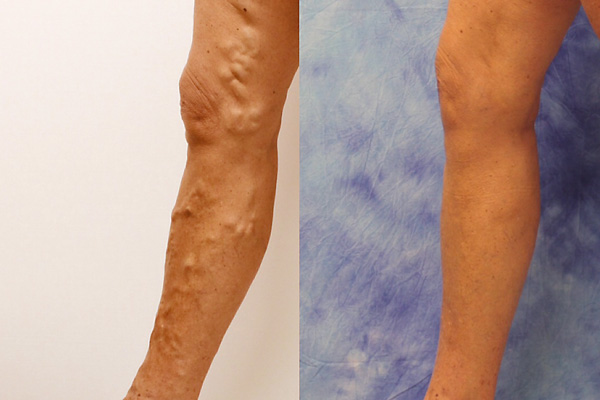
Before & After: Visible results from vein treatment

This 56-year-old VHC patient had all the typical symptoms of venous disease, in addition to a history of ulcers at her ankle, bleeding from her varicosities, and a past vein stripping. EVLA treatment, followed by five sessions of sclerotherapy, resolved all of her issues.


Many of the symptoms of venous disease are invisible to the eye, though they affect people greatly. For example, one Vein Healthcare Center patient had no pain in her legs, but they felt "like cement" at the end of the day. She couldn't move them!

For other patients, vein problems are right there on the surface. 

Every single case is different so, of course, results vary. But when the source of the problem is located (using ultrasound mapping), then treatment is more likely to be effective.

Since a picture is worth a thousand words, take a look at pictures of former patients of the Vein Healthcare Center. Every person has different vein issues, and we customize a treatment plan for each individual to address his or her specific goals. 

If you're ready to discuss your vein health, contact us! We're happy to answer your questions.


Monday, September 17, 2018

Board certification: what it is and why it’s important

People have various motivations for seeking vein treatment, including aesthetic reasons, but it’s important to remember that treatments for spider veins or varicose veins — as minimally invasive as they may be — are still medical procedures. That’s why it’s important to be informed and to go to a provider who is certified by the American Board of Venous & Lymphatic Medicine (ABVLM).


The ABVLM, formerly the American Board of Phlebology, was established in 2007 to improve the standards of medical practitioners and the quality of patient care related to the treatment of venous disorders and all aspects of venous disease.

The ABVLM also offers a Board Certification Exam, which ensures that physicians who specialize in phlebology (vein care) have met rigorous standards of education, experience, and evaluation. In addition to passing the exam, diplomates must demonstrate their experience and continuing medical education in the field. To that end, the ABVLM has also established educational standards for teaching and training programs in phlebology.

The ABVLM and the establishment of a Board Certification Exam brings recognition to both the field of phlebology and those providers in the field who have the knowledge, skills, and experience to provide quality care to phlebology patients. While many practice in the field of phlebology in Maine, there are just six Board certified phlebologists in the state who meet this high standard.

In addition to being a Board certified vein specialist, Dr. Cindy Asbjornsen is also the only doctor in Maine to be named a Fellow by the American College of Phlebology.

If you would like to schedule an appointment with Dr. Asbjornsen, please contact us at Vein Healthcare Center. We look forward to meeting you!