Showing posts with label economy class syndrome. Show all posts

Tuesday, April 23, 2019

Healthy Veins seminar with Dr. Cindy

Dr. Cindy Asbjornsen, Founder of the Vein Healthcare Center, truly loves to educate people -- patients and doctors, alike -- about vein health.

Dr. Asbjornsen recently gave a community seminar at Coastal Pharmacy & Wellness in Portland, Maine, where she discussed the basics of how veins work...and what to do when they don't. And, she explained what phlebology is!

Participants asked tons of great questions, including what do do about the so-called "Economy Class Syndrome" and DVT. 

Dr. Asbjornsen explained that you don't need to be in economy class (or even on an airplane) to be at risk for bad circulation. It's really about sitting in the same position for too long. A long car ride, for example, can have the same effect. 

Dr. Cindy's simple and practical advice for keeping your veins healthy during a lengthy car ride is three-fold. One, do the calf pump frequently (also known as "the foot pump"). Two, stay hydrated. Three, stop for restroom breaks! That will get your calf muscles moving AND give you a reason to keep drinking water during the ride.

Click here to watch the vein seminar. Click here to contact schedule an appointment, or to ask us any questions. We look forward to hearing from you!

Tuesday, June 9, 2015

Summer and veins

After a long and especially frigid New England winter, it will officially be summer in just a few weeks. What does that mean for those who suffer from vein disease symptoms, such as throbbing, aching legs, legs that tire easily…or having to wear shorts?

We’ve compiled a few @VHC blog posts to help you navigate vein issues (and treatment) during the summer months:
  • Don’t let varicose veins ruin your summer. Click here to read.
  • Vein treatments in the summer, Part 1. Click here to read.
  • Vein treatments in the summer, Part 2: Click here to read.
And for those who are traveling this summer, prevent blood clots on long trips by plane, train or automobile. Click here to read.

If you have any questions about vein health, whatever the season, you’re welcome to contact the Vein Healthcare Center. And happy almost summer!

Tuesday, May 19, 2015

Fashionable...compression?

Graduated compression stockings are ugly, beige, and only for “old people,” right?

Wrong. In the past several years, compression companies, such as Juzo, SIGVARIS, Carolon and Jobst, have been developing stockings and socks in styles, patterns, finishes, and colors that look more like fashion accessories than medical devices (while still being clinically effective when purchased and put on correctly.)

Newer brands like REJUVA and ITEM m6 (a spin-off of compression manufactuer medi) are also taking compression trends to the streets. Both companies were mentioned in an article about compression in the NYTimes Style section!

Read more about how compression has evolved in Healthy Style: Compression Steps Up, the latest cover story in Vein Health News. Just click here to read the story.

Tuesday, August 19, 2014

The calf pump


Is “the calf pump” a new dance all the kids are doing? No, it has something to do with veins, of course! Namely, making sure the circulation in your legs is working properly.

As summer draws to a close, many people are returning from vacation, driving in their cars, or hopping a long flight home. In order to prevent deep vein thrombosis (known as DVT), try the foot pump, in the car or on the plane.

It’s a simple toe-tap exercise: tap your feet for a minute or two, going back and forth between heels and toes. This squeezes the deep veins in the legs and forces the blood to circulate through the leg. It also feels good after sitting for a long period of time. Do the foot pump (on each foot) every half-hour or so.

Also, don’t forget to stay hydrated, preferably with water. And try to take a brief walk in the airplane aisles (or at the rest stop) occasionally to keep the blood flowing.  


Tuesday, March 11, 2014

DVT: symptoms to look for and step toward prevention


Last week we described what DVT is and who is at the greatest risk for getting one. Now let's look at the most common symptoms to watch out for.

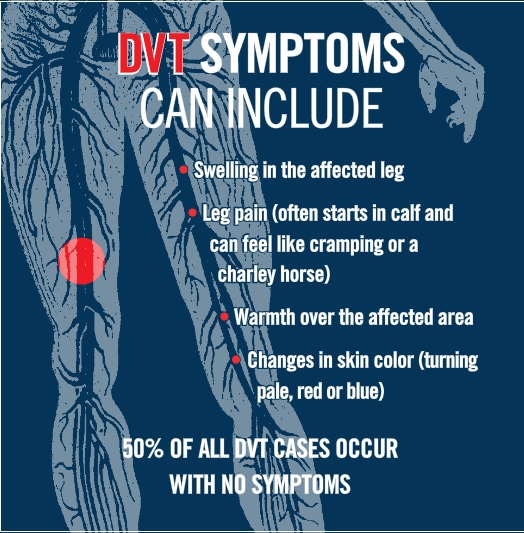
In most cases, the affected area-- usually in the leg-- will be painful, swollen or tender, with a redness or discoloration of the skin. Even a muscle cramp that feels especially sharp and painful can be an indication of DVT. DVT is a medical emergency, so any symptoms should be regarded as a DVT until proven otherwise, especially if someone is in a risk category. 
It's important to note that about half of the time, DVT has no symptoms at all.

The good news is that DVT can be prevented! And because DVT can occur with little or no warning, the best action to take is prevention. Without preventive treatment, for example, up to 60 percent of patients who undergo total hip replacement surgery may develop DVT. 

The Centers for Disease Control and Prevention (CDC) recommends the following tips for DVT prevention: 
  • Understand your level of risk, and talk to your doctor about DVT, especially if you're in a high-risk group.
  • Maintain a healthy weight, eat a healthy diet and don’t smoke.
  • Exercise regularly.
  • Move around as soon as possible after surgery, illness or injury. Even passive movement helps.
  • When traveling or sitting for more than four hours get up and walk around every few hours and exercise legs while sitting.
  • Drink plenty of water and avoid alcohol or caffeine.
To find out more about DVT symptoms and prevention, go to www.stoptheclot.org.

Tuesday, March 4, 2014

March is DVT Awareness Month


More than 1,240 Mainers succumb to DVT- (deep vein thrombosis) and PE-related (pulmonary embolism) deaths every year, according to the Mayo Clinic. And this estimate is likely on the low side.

In fact, the annual mortality rate of blood clots is greater than yearly deaths in the U.S. from breast cancer, AIDS and automobile accidents combined. Though most people know about these issues, DVT is still under-recognized. 

March is DVT and Blood Clot Awareness Month. It's a chance for the medical community to educate the public about a medical condition that affects approximately two million Americans annually.

All month long we'll be taking a closer look at DVT: what it is, who is at risk, and what you can do to prevent ever getting one.

So what is DVT? Deep vein thrombosis (DVT) is a blood clot in the deep vein system. The danger is that the clot could break free from the vein wall and enter into the blood stream. The clot could then travel to the lungs and become a PE (pulmonary embolism), or to the brain and result in a stroke. DVT-related PE is the leading cause of preventable death in U.S. hospitals.

Anyone can get a DVT and at any age. Certain groups, however are at a greater risk of developing a life-threatening blood clot. 
  • Those with prolonged immobility or no mobility, like patients in the hospital or on bed rest, or long-distance travelers (so-called “economy class syndrome”)
  • People with blood-clotting issues, like those with a genetic disorder, or cancer patients undergoing surgical procedures
  • Patients with damage to their vein walls because of surgery or injury
  • Pregnant women are more susceptible to DVT because of hormonal changes
  • Seniors 
This is, by no means, a complete list of risks, and it's important to remember that risk factors can be compounded. For example, combining an existing blood clot disorder with immobility can dramatically raise the risk of deep vein thrombosis.

Having risk factors does not mean that you will surely get a DVT-- rather, you should be proactive about prevention.

Take this month to learn more about DVT, take an online risk assessment, and ask your physician if you may be at risk.

Wednesday, July 17, 2013

Should You Be Worried About “Economy Class Syndrome”?

Concerns about blood clots as a result of Deep Vein Thrombosis (DVT) increase during summer travel season. Blood clots can be dangerous, even fatal – but they can be prevented.


It’s the height of the summer and for many, July marks the beginning of travel season. It’s the time spent en route to vacation destinations that lead to concerns about “economy class syndrome,” a term used to describe leg symptoms that can occur as a result of long periods of immobility.

These extended periods of immobility can be associated with deep vein thrombosis, or DVT, a blood clot in the deep vein system. DVT can be cause for concern because the clot could break free from the vein wall and enter into the blood stream, traveling to the lungs and become a PE (pulmonary embolism), or to the brain and result in a stroke.

Though a familiar term to many, “economy class syndrome,” is actually a misnomer. DVT can occur in a plane, train or automobile, regardless of what class you’re sitting in. The point is that prolonged immobility can slow down circulation and lead to blood pooling in the legs, which significantly increases the risk of DVT.


Prevent DVT During Summer Travel

If you’re planning to go on a long flight (or road trip, for that matter), you can minimize the risk of DVT. First, stay hydrated. Then, make a point of walking in the aisles (or at the rest stop) occasionally. Finally, periodically do simple toe-tap exercises – that means tapping the feet for a minute or two, going back and forth between heels and toes. This “foot pump” squeezes the deep veins in the legs, forcing the blood to circulate.

By increasing mobility and making healthy blood flow a priority while you travel, you can help keep blood clots at bay this summer – and any time of year.

Are you at risk for DVT? Visit the Vein Healthcare Center to learn about the risks and steps toward prevention.

The Centers of Disease Control and Prevention also offers more information about Deep Vein Thrombosis and its symptoms and risk factors.