Tuesday, October 30, 2018

Spider Veins Don’t Have to be Scary!


Telangiectasia is the technical term, but most people know them as “spider veins.” The red, blue or purple veins that occur just under the surface of the skin may appear as short fine lines, clusters, or in a spider web shape.

According to Dr. Cindy Asbjornsen, spider veins can be an indication of early stage vein disease— the “tip of the iceberg,” if you will. Vein health is a continuum, so while spider veins may appear minimal, there could be a larger vein “leaking” underneath.

Here are some tips for coping with spider veins:
  • Elevate your legs above your heart as often as possible— for as long as 30 minutes or as briefly as three minutes. The ideal time is after you have been standing for a long period or after a hot shower.
  • Sit properly. Focus on good posture and avoid crossing your legs, or sitting in ways that can compress veins for prolonged periods.
  • Walk. Walking causes the rhythmic contraction of calf muscles and helps promote blood flow to the heart. Just 30 minutes every day— all at once, or in shorter increments.
  • Contact a board certified phlebologist for an evaluation. In the past, treatment for spider veins has been considered merely cosmetic, but spider veins are symptoms of early stage vein disease and left untreated can lead to increased symptoms.

Sclerotherapy is frequently used to treat spider veins and smaller veins. In this procedure, tiny needles inject a medicine called a sclerosing agent into the vein's interior wall. This substance causes the vein to become sticky and seal shut, causing the troublesome vein to disappear. Blood then finds a healthy path back to the heart.

With modern sclerosants, there is little risk of complication, and patients often experience an immediate relief of symptoms. Most patients can return to their regular activities after the procedure is over.

Treating spider veins can improve appearance but more importantly, treatment can help stop the progression of venous disease at its source.

To find out more about spider veins, sclerotherapy, and vein treatments, contact us at the Vein Healthcare Center. We look forward to hearing from you!

Tuesday, October 16, 2018

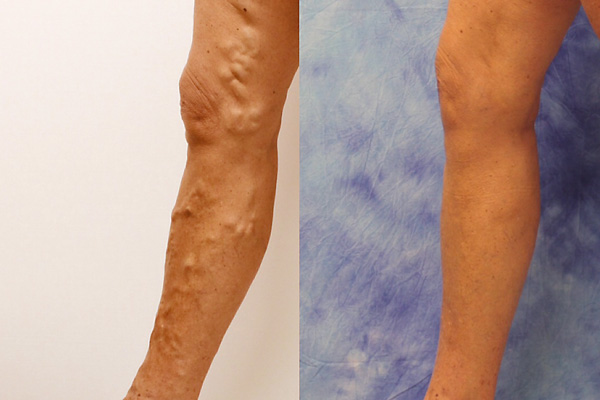
Before & After: Visible results from vein treatment

This 56-year-old VHC patient had all the typical symptoms of venous disease, in addition to a history of ulcers at her ankle, bleeding from her varicosities, and a past vein stripping. EVLA treatment, followed by five sessions of sclerotherapy, resolved all of her issues.


Many of the symptoms of venous disease are invisible to the eye, though they affect people greatly. For example, one Vein Healthcare Center patient had no pain in her legs, but they felt "like cement" at the end of the day. She couldn't move them!

For other patients, vein problems are right there on the surface. 

Every single case is different so, of course, results vary. But when the source of the problem is located (using ultrasound mapping), then treatment is more likely to be effective.

Since a picture is worth a thousand words, take a look at pictures of former patients of the Vein Healthcare Center. Every person has different vein issues, and we customize a treatment plan for each individual to address his or her specific goals. 

If you're ready to discuss your vein health, contact us! We're happy to answer your questions.


Monday, September 17, 2018

Board certification: what it is and why it’s important

People have various motivations for seeking vein treatment, including aesthetic reasons, but it’s important to remember that treatments for spider veins or varicose veins — as minimally invasive as they may be — are still medical procedures. That’s why it’s important to be informed and to go to a provider who is certified by the American Board of Venous & Lymphatic Medicine (ABVLM).


The ABVLM, formerly the American Board of Phlebology, was established in 2007 to improve the standards of medical practitioners and the quality of patient care related to the treatment of venous disorders and all aspects of venous disease.

The ABVLM also offers a Board Certification Exam, which ensures that physicians who specialize in phlebology (vein care) have met rigorous standards of education, experience, and evaluation. In addition to passing the exam, diplomates must demonstrate their experience and continuing medical education in the field. To that end, the ABVLM has also established educational standards for teaching and training programs in phlebology.

The ABVLM and the establishment of a Board Certification Exam brings recognition to both the field of phlebology and those providers in the field who have the knowledge, skills, and experience to provide quality care to phlebology patients. While many practice in the field of phlebology in Maine, there are just six Board certified phlebologists in the state who meet this high standard.

In addition to being a Board certified vein specialist, Dr. Cindy Asbjornsen is also the only doctor in Maine to be named a Fellow by the American College of Phlebology.

If you would like to schedule an appointment with Dr. Asbjornsen, please contact us at Vein Healthcare Center. We look forward to meeting you!

Tuesday, September 4, 2018

What is phlebology?


Veins are not a new invention. But phlebology – the study and treatment of veins and venous disease – is a relatively recent field of medicine. Once a sideline of vascular surgeons (whose focus was and is mainly arteries), phlebology is a burgeoning discipline that continues to add skilled specialists to its ranks.

Dr. Raymond Tournay first coined the term phlebology in 1947: “phlebo” meaning “vein,” and “ology,” meaning any science or branch of knowledge. Tournay and his colleagues founded the French Society of Phlebology (SFP), also in 1947, and he was its General Secretary for many years.

The American College of Phlebology (ACP) was founded in 1985 by Dr. Anton Butie, though its original name was the North American Society of Phlebology. Its purpose was to bring together physicians and surgeons from diverse specialties who shared an interest in venous disease. The Society started with just fourteen members. Today, the ACP has over 2,000 physicians and allied health professional members, including physician assistants, advanced practice nurses, and ultrasound specialists and technologists.  

In 2005, phlebology was approved for inclusion in the list of self-designated medical specialties sanctioned by the American Medical Association (AMA). The decision by the AMA meant that physicians who diagnose and treat venous disorders, including varicose veins, could select phlebology as their primary or secondary area of practice.

Dr. Helane Fronek, editor of The Fundamentals of Phlebology: Venous Disease for Clinicians and a pioneer in the field, called the recognition “tremendous.” 

In 2007, the American Osteopathic Association (AOA) followed the AMA’s lead and officially recognized phlebology as a distinct practice discipline.

Venous disease is extraordinarily common, but historically it has been poorly understood in the medical community. However, as the awareness of vein disorders and modern treatments has grown— among healthcare professionals and the general public— history is quickly changing.

To see how phlebology can improve your health and quality of life, contact us at Vein Healthcare Center. We're happy to answer any of your vein questions.

Tuesday, August 21, 2018

In the swim: one patient's perspective


For some active folks in New England, summer means swimming. For Nathan, age 44, swimming isn't just a hobby, it's his passion. 

A swimmer since his youth, Nathan began to develop varicose veins in both legs in his twenties. The blue, raised veins in his left leg were especially severe. He asked several doctors and physical therapists about it over the years, showing them how the bulging veins were considerably warmer than the rest of his leg. They all told him that there was nothing he could do about it, sometimes suggesting aspirin or compression sleeves to manage the discomfort.

It wasn’t until Nathan visited Dr. Asbjornsen, a Board certified phlebologist, that he realized that his symptoms—the cramping, fatigue, and varicose veins—were related to circulation and venous disease. After a physical exam, diagnostic ultrasound evaluation, and a full review of his medical history, Nathan learned that he was predisposed to varicose veins and that if he didn’t treat them, his condition would continue to get worse.

He decided to have the endovenouslaser ablation (EVLA) procedure done on his left leg, and then about eight months later, he had the procedure on his right leg. Recovery from both treatments was relatively quick, and the results were obvious. The cramping and pain went away, and his shoe size went down half a size because there was no more swelling.

Nathan’s quality of life improved, and so has his swimming: “I have new legs as far as I’m concerned. I have more endurance, and I can push myself much harder. I have more cardio, which is surprising to me. I can go further, faster, because the blood is returning and able to take oxygen to the places I need it. I was not aware of how much better I could feel—or that I could be a faster swimmer.”

Nathan had no idea what he was in for when he got his varicose veins treated. While he did expect to feel some relief from the leg pain and cramping he had experienced for years, he did not expect to become a better athlete.

Are you looking for relief from leg pain, varicose veins, or other venous issues? Contact the Vein Healthcare Center to make an appointment for a thorough exam. 

Tuesday, August 7, 2018

Vein tips for hot days

Heat dilates veins. That means that varicose veins (or "leaky" veins) and other symptoms can worsen in warmer weather. 

Here are some quick tips for vein relief:
  • Stay as cool as possible. 
  • Stay hydrated. Drink plenty of water.
  • Take a walk. If the temperature outside is too hot, try a stroll through the mall or another climate-controlled building.
  • Go for a swim. Like walking, swimming pumps the calf muscles and improves circulation. Plus, a swim can cool you off!
  • Elevate the legs whenever possible.
  • Schedule an evaluation with a Board certified phlebologist.
Click here for additional ways to ease symptoms of vein disease. Click here to schedule an appointment for a complete evaluation of your vein health so you can treat the problem at its source.

Thursday, June 14, 2018

Be aware of DVT and travel safely this summer

Summer may be BBQ season, but it’s also the time when people travel long distances in planes, trains, and automobiles. For us in vein healthcare, that means increased risks of Deep Vein Thombosis, or DVT.

The deep vein system carries about 80% of blood from the feet back up to the heart. Deep veins are located under the muscle and connective tissue layers in the legs. A blood clot in a deep vein can be dangerous because the high pressure in the system could cause the clot to break free from the vein wall and enter the blood stream. The DVT could then travel up through the legs into another part of the body such as the lungs, where it would become a pulmonary embolism (PE).

DVT or PE symptoms are often misinterpreted as something less serious. A blood clot in the leg may feel like a “charley horse,” shin splints, or a twisted ankle. Symptoms from PE are often attributed to a pulled muscle in the chest, costochondritis (inflammation of the joint between ribs and breast bone), asthma, or a “touch of pneumonia.”

So what are some of the signs to look for? For DVT, the leg may be warm to the touch; swelling in the leg (can also occur in the arm); leg (or arm) pain or tenderness; reddish or bluish skin discoloration.

For PE, be aware of a sudden shortness of breath; sharp, stabbing chest pain (may get worse with deep breath); rapid heart rate or breathing; feeling lightheaded or fainting; unexplained coughing, sometimes with bloody mucus.

In half of DVT and PE cases, no symptoms present at all—but both conditions are medical emergencies. Any of these symptoms should be regarded as a DVT or PE until proven otherwise, especially if someone is in a risk category (including whether there is a history of blood clots in your family).

Awareness is key-- and so is prevention. When traveling long distances, stay well hydrated, stretch legs your legs and pump your feet periodically, avoid or moderate alcohol and caffeine, and consider wearing graduated compression stockings on your trip.

To find out more about DVT and other vein issues, contact us at the Vein Healthcare Center. We will evaluate your vein health — including spider veins, varicose veins, and leg ulcers.