Showing posts with label venous disease symptoms. Show all posts

Tuesday, October 30, 2018

Spider Veins Don’t Have to be Scary!


Telangiectasia is the technical term, but most people know them as “spider veins.” The red, blue or purple veins that occur just under the surface of the skin may appear as short fine lines, clusters, or in a spider web shape.

According to Dr. Cindy Asbjornsen, spider veins can be an indication of early stage vein disease— the “tip of the iceberg,” if you will. Vein health is a continuum, so while spider veins may appear minimal, there could be a larger vein “leaking” underneath.

Here are some tips for coping with spider veins:
  • Elevate your legs above your heart as often as possible— for as long as 30 minutes or as briefly as three minutes. The ideal time is after you have been standing for a long period or after a hot shower.
  • Sit properly. Focus on good posture and avoid crossing your legs, or sitting in ways that can compress veins for prolonged periods.
  • Walk. Walking causes the rhythmic contraction of calf muscles and helps promote blood flow to the heart. Just 30 minutes every day— all at once, or in shorter increments.
  • Contact a board certified phlebologist for an evaluation. In the past, treatment for spider veins has been considered merely cosmetic, but spider veins are symptoms of early stage vein disease and left untreated can lead to increased symptoms.

Sclerotherapy is frequently used to treat spider veins and smaller veins. In this procedure, tiny needles inject a medicine called a sclerosing agent into the vein's interior wall. This substance causes the vein to become sticky and seal shut, causing the troublesome vein to disappear. Blood then finds a healthy path back to the heart.

With modern sclerosants, there is little risk of complication, and patients often experience an immediate relief of symptoms. Most patients can return to their regular activities after the procedure is over.

Treating spider veins can improve appearance but more importantly, treatment can help stop the progression of venous disease at its source.

To find out more about spider veins, sclerotherapy, and vein treatments, contact us at the Vein Healthcare Center. We look forward to hearing from you!

Tuesday, October 16, 2018

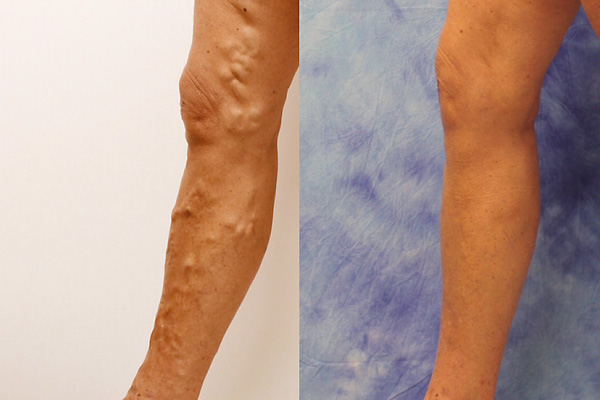
Before & After: Visible results from vein treatment

This 56-year-old VHC patient had all the typical symptoms of venous disease, in addition to a history of ulcers at her ankle, bleeding from her varicosities, and a past vein stripping. EVLA treatment, followed by five sessions of sclerotherapy, resolved all of her issues.


Many of the symptoms of venous disease are invisible to the eye, though they affect people greatly. For example, one Vein Healthcare Center patient had no pain in her legs, but they felt "like cement" at the end of the day. She couldn't move them!

For other patients, vein problems are right there on the surface. 

Every single case is different so, of course, results vary. But when the source of the problem is located (using ultrasound mapping), then treatment is more likely to be effective.

Since a picture is worth a thousand words, take a look at pictures of former patients of the Vein Healthcare Center. Every person has different vein issues, and we customize a treatment plan for each individual to address his or her specific goals. 

If you're ready to discuss your vein health, contact us! We're happy to answer your questions.


Monday, June 4, 2018

Dealing with veins in the summer


Although the first day of summer is technically June 21, many New Englanders consider Memorial Day to be the unofficial start of the summer. 

’Tis the season for people to dust off their BBQ grills and motorcycles— and shorts, swimsuits, and sandals. This time of year brings joy to most, but for those dealing with vein issues, it can produce discomfort and anxiety.

If you suffer from symptoms of vein disease, shorts season can be a tough time. Here are a few @VHC blog posts that can help:

  • Don’t let varicose veins ruin your summer. Click here to read.
  • Vein treatments in the summer, Part 1. Click here to read.
  • Vein treatments in the summer, Part 2: Click here to read.

To find out more about how to treat vein issues, contact us at the Vein Healthcare Center. We will evaluate your vein health — including spider veins, varicose veins, and leg ulcers — and recommend the best treatment for your individual condition and health goals. Schedule your appointment today.

Tuesday, April 3, 2018

Listen to your legs

Sometimes venous disease is very obvious. Bulging, twisty veins that wrap around your legs is one manifestation. Purple spidery veins on the backs of your thighs may be another. But there are other, more subtle clues that your veins may not be working as well as they should.

Do your legs sometimes feel achy or throbbing? Do you have leg cramps in the middle of the night? Are your legs exhausted by the end of the day?


These may be signs of vein disease, and it's best not to ignore them for a couple of reasons. For one thing, your body is trying to tell you something is wrong. Waiting for the issues to go away on their own may actually make them worse as time goes on. If you find out what the problem is, you can take steps to fix it!


Sue, age 63, from North Yarmouth, Maine is one of our patients at the Vein Healthcare Center. Here's what Sue had to say about her own experience:

“I work at a daycare and when I came home at the end of the day, my legs were like cement. I could not move them. It was affecting me tremendously but because it didn’t hurt, I had no idea my veins were the problem. I had EVLA done in both legs, and they felt much lighter right away.”
You can read more patient experiences like Sue's by clicking here. If you are having issues with your legs that you can't quite explain, take a look at this list of questions, and see if you can relate. Finally, contact us at the Vein Healthcare Center to make an appointment for an evaluation of your venous system. There may be a way to fix the problem.

Tuesday, March 13, 2018

Picking the right shoes

In the last issue of Vein Health News, we talk about ways to treat (and prevent) sore feet and legs for people who stand for long periods of time.

Chris Stanley, pedorthist and director of training at Lamey Wellehan Shoes, was one of the experts who gave us some advice on caring for achy feet.

According to Chris, the number one statement that they hear from their clients is: “I'm on my feet all day, and I need a comfortable shoe.”

Here are a few tips: 

  • When it comes to foot fatigue and comfort, the best treatment is an evaluation of what the person is currently wearing for shoes. About 80% of Americans are wearing shoes that don't fit correctly (often they are too small) and that can cause discomfort, especially toward the end of the day when the feet end up changing in shape and volume.
  • When looking at new shoes, many people want to have soft, spongy cushions under their feet, but in most cases, that can be detrimental. Having support characteristics in a shoe will actually reduce foot fatigue and increase comfort.
  • When shopping for work shoes, shop at a shoe store that measures feet and offers a variety of brands and styles. If the salesperson doesn't offer to measure your feet and doesn't bother to review how your shoes fit, then go to a different store. The proper shoe, matched with the proper size, often can solve many comfort-related issues.
  • Take time to stretch. Calf stretches will help to pump blood up out of the foot and generally improve blood circulation. Rolling your foot over a tennis ball or a foot massager will help the intrinsic foot muscles.

Tired, aching legs may also be a symptom of vein disease, a condition that is highly treatable. Click here to see if you have any of the common signs of vein disease. And remember, legs aren’t supposed to hurt, even at the end of a long workday!

If you have any questions, you’re always welcome to contact us at the Vein Healthcare Center.

Thursday, September 28, 2017

Standing on the job

Do you work at the kind of job where you’re on your feet all day? (Nurses, teachers, and restaurant workers, we're talking to you!)

In our latest issue of Vein Health News, we look at the risks of being on your feet all day at work, as well as the role that veins may play in causing leg pain or discomfort after prolonged standing. The article explains the symptoms that indicate that leg pain may be due to vein disorders— symptoms that are often mistaken for something else.

Of course, the article also explores modes of treatment and prevention. We offer tips from experts in podiatry, pedorthics, compression, and even a nail technician. Read on to find out more about what you can do to take care of your feet so that they can keep you healthy and moving forward!

To learn more about this and other current topics in vein healthcare, click here. And if you’d like to take the next step in your vein health, click here.


Monday, June 12, 2017

Men’s health includes healthy veins

Men don’t get varicose veins, right? Of course they do! Men are just as likely to suffer from vein issues than women.

June 12-18 is Men’s Health Week, a chance for men to take stock of their health and habits – including varicose veins and other vein problems often associated with women.

Here are the facts: Anatomically, men’s leg veins are no different from women’s veins. Looking at a leg ultrasound, one would be hard-pressed to tell the difference between a man’s and a woman’s legs.

Everyone’s veins carry blood from the legs and arms back to the heart. The blood in the legs travels up against gravity, so when the valves in the veins become damaged, blood “leaks” back into the legs and creates a “pooling” effect.
           
Who has the highest risk of getting varicose veins? Heredity plays a strong role, so look at your family history for clues. Lifestyle is also a significant risk factor: does your job require you to stand for long periods of time, or do you sit at your desk all day? Advanced age or previous leg trauma can also affect your venous health.

Even men who are athletic are susceptible to venous (vein) disease. Sometimes men with vein problems misinterpret their symptoms, mistaking the pains of venous disease for a strained or pulled muscle.

Like any chronic medical condition, varicose veins get worse with time, and the longer one waits, the more extensive the condition could become. Many men go to their doctors for the first time when they get venous ulcers, a problem too painful to ignore.

Treatment can stop the progression of venous disease and its complications for those in all stages of disease, however, early intervention is best and provides the most improved quality of life. But for those men (or women) struggling with late-stage symptoms it is still possible to restore health. Today's vein treatments are minimally invasive, cause very little pain, and can be accomplished quickly right in a physician’s office.
           
The key for men is to get evaluated as soon as the symptoms become apparent or they suspect there’s a problem.

Schedule your evaluation and learn how treatment could improve your health and quality of life.

Monday, May 8, 2017

Happy National Nurses Week!

May 6-12 is National Nurses Week, sponsored by the American Nurses Foundation. This
year's theme is "Year of the Healthy Nurse."

To celebrate and support nurses everywhere, we offer some healthy leg tips for nurses who are on their feet all day.

Did you know that varicose veins can be an occupational hazard for nurses? One tried and true way to reduce the effects of vein disease -- and in some cases, prevent symptoms -- is graduated compression. 

Please note that so-called "support hose" does not have to be ugly! Not today, with the many styles and colors that are available. 

Another remedy for aching legs is to elevate them periodically and at the end of the day. This post explains how to properly elevate legs. Lastly, nurses should remember to care for their feet. Here are some tips from the blog RN Central.

Happy National Nurses Week to all of the nurses out there. Thank you for all you do!

Visit the Vein Healthcare Center in South Portland, Maine, or learn more about Dr. Cindy Asbjornsen.

Tuesday, March 14, 2017

Physical activity, leg pain…and veins?

Many athletes, professionals and amateurs alike, experience some kind of leg pain at one time or another, whether from the mechanics of pounding movement on a hard surface, or keeping their legs in the same position for extended periods. Rarely do they attribute the discomfort to a dysfunction in their venous (veins) system.

But not all aching legs are simply due to physical activity, or even the effects of aging. It may actually be vein insufficiency that’s causing those symptoms and not that five-mile run.

The first thing to understand that leg pain in general is not normal. If your legs hurt after exercise, you should find out why.

Some of the symptoms of vein disease are obvious: visible blue- or purple-colored “spider veins,” bulging varicose veins, or even open wounds (leg ulcers) on the leg or ankle. Other symptoms are much more subtle. In addition to achiness and swelling, sensations like an itching or tingling in the legs may be an indication of vein insufficiency. Leg cramps after long periods of inactivity, or while lying in bed at night, is another possible symptom.

Some people may experience no symptoms at all—and some merely accept them as an unavoidable byproduct of physical fitness. You can be in great shape and still have a vein disease that’s developing.

In our next post, we’ll look at how exercise impacts veins (and vice versa). If you wonder whether vein issues are affecting your physical performance, feel free to call the Vein Healthcare Center with any questions.

Tuesday, February 28, 2017

Hidden signs of vein disease

Sometimes vein disease is unmistakable. Large, bulging varicose veins are a sure sign, as are bluish spider veins. But sometimes vein issues are harder to detect.

The 65-year-old woman in the picture to the right sought help because of veins in her right leg, but in her initial evaluation it became apparent through skilled ultrasound mapping that both legs were affected. Even she didn’t realize the disease was actually worse in her left leg than her right.

Other symptoms that may indicate vein problems are heaviness or aching in the legs. Swelling, throbbing, cramping, or burning sensations in the leg are other signs, as are restless legs. If you think you might be suffering from one or more symptoms of vein disease, ask yourself these 12 questions to find out more.

As for the patient in the picture, she had EVLA treatment on both legs, followed by ultrasound-guided sclerotherapy. Both of her legs – and her quality of life – have distinctly improved.

Tuesday, December 6, 2016

A round-up of “how to’s”

Over the years, we’ve posted a lot of quick tips for vein care at home, so as a year-end gift we’re putting them all in one place!
Don’t forget that while these “how to’s” can help with the symptoms of vein disease, an evaluation by a qualified phlebologist can give you a complete picture of your venous health and options for treatment. If you ever have any questions, don’t hesitate to contact us at the Vein Healthcare Center.

Happy holidays from all of us at VHC!

Wednesday, July 6, 2016

Men, women and veins

Gender and age are two primary risk factors in the development of venous insufficiency. The U.S. estimate for varicose veins is 40% in females and 22% in males. 72% of American women and 42% of men will experience varicose veins symptoms by the time they reach their sixties (although vein problems can occur at almost any age).

While it’s true that women are more likely than men to have venous disease, including varicose veins and spider veins, men are more likely to suffer from the worst vein problems, such as ulcers. Why is this the case?

Dr. Cindy Asbjornsen has observed that women tend to get help for their vein issues right away, while men will often wait until the problem becomes too painful to ignore. Leg ulcers, or wounds that won’t heal, are often the result. Conditions like varicose veins get worse with time, so the longer someone waits, the more extensive the condition—and often, the treatment.

Even men who are athletic are susceptible to venous disease. The important thing is to seek help for vein issues as soon as symptoms present themselves.

Symptoms of venous disease include:
  •     Leg fatigue or heaviness – It is an early warning sign when legs feel good upon waking but are intensely tired or heavy at the end of the day.
  •     Swelling – This can be caused by many things but also serves as a very early warning sign for vein problems.
  •     Skin changes – Redness, skin thickening or other color changes on the legs and/or ankles is a common (and commonly overlooked) symptom.
  •     Other skin changes, such as dermatitis, cellulitis, dry or scaly skin, or brown “stains” on the skin can be signs of advanced venous disease, and should be evaluated by a physician.
  •     Spider veins – Blue- or purple-colored veins that occur under the skin but are close enough to be seen on the surface can be the “tip of the iceberg.
  •     Varicose veins – Another sign of early stage venous disease, varicose veins are visible veins in the leg that bulge, often protruding through the skin.
  •     Ulcers – An open wound on the leg or ankle that fails to heal can be the result of ongoing venous disease, often an indication that venous disease has reached an advanced stage.
Remember, some people with venous disease present with no symptoms, only skin changes and/or bulging veins. The key for anyone, regardless of gender, is to get evaluated as soon as he or she suspects there’s a problem.

Tuesday, January 12, 2016

How to tell if you have venous disease

Have you ever thought that the spider veins behind your knees have gotten bigger as you’ve gotten older? Or have you wondered why your legs feel so tired at the end of the day?

The American College of Phlebology (ACP) now offers a free, online vein self-assessment resource, which includes a questionnaire with eight simple questions to help determine if someone is at risk for vein issues.

Throughout the assessment, you’ll learn facts about vein issues to help you gain a better understanding of your own possible vein condition. Of course, an excellent way to find out if you do or do not have a vein disorder is to be evaluated by a Board-certified vein specialist.

To take the assessment screening, visit www.phlebology.org/VeinAssessment

Tuesday, June 23, 2015

Changes in the skin

Did you know that changes in the skin might be a clue to venous disease?

If you notice redness around the ankles, see other color changes on your legs, or find that your skin has become harder or thicker in the lower leg, it’s likely you are experiencing a common symptom of venous disease. These skin changes can be mild, or they can cause pain and involve larger areas of the skin.

Other skin changes, such as dermatitis (inflammation of the skin), cellulitis (bacterial skin infection), dry or scaly skin, or brown “stains” on the skin, can be signs of advanced venous disease.

If you do observe these types of changes—especially if you are experiencing other vein symptoms, such as aching or throbbing legs, or if vein problems run in your family—consider talking to your primary care doctor, or visiting a physician who specializes in vein health.

Tuesday, June 9, 2015

Summer and veins

After a long and especially frigid New England winter, it will officially be summer in just a few weeks. What does that mean for those who suffer from vein disease symptoms, such as throbbing, aching legs, legs that tire easily…or having to wear shorts?

We’ve compiled a few @VHC blog posts to help you navigate vein issues (and treatment) during the summer months:
  • Don’t let varicose veins ruin your summer. Click here to read.
  • Vein treatments in the summer, Part 1. Click here to read.
  • Vein treatments in the summer, Part 2: Click here to read.
And for those who are traveling this summer, prevent blood clots on long trips by plane, train or automobile. Click here to read.

If you have any questions about vein health, whatever the season, you’re welcome to contact the Vein Healthcare Center. And happy almost summer!

Tuesday, March 17, 2015

Leg ulcers, an advanced stage of vein disease

Leg ulcers can occur at any stage of life and, without treatment, can cause overwhelming problems. 

When blood pools in the lower leg over a long period of time, the condition is referred to as venous stasis. When blood leaks into the tissue of the skin it can cause swelling and damage to the tissue. Tissue damage can result in wounds, or ulcers, that are chronic and do not heal if the condition is left untreated. Ulcers may be painful or itchy and often require constant care and dressing.

There are three large classes of ulcers: diabetic, arterial, and venous. Of the three types, venous, or vein-related, is the most common. In fact, venous disease is thought to account for approximately 80% of chronic leg ulcers. Venous ulcers can be caused by venous insufficiency or by a wound that has been exacerbated by venous insufficiency. 


Leg ulcers are often an indication that vein disease has reached an advanced stage. However, the key to properly treating and managing them is to first get them diagnosed. Though ulcers may appear similar, each one has a different cause and thus, very different treatments.

Clinical appearance is the first clue to distinguishing between venous and arterial ulcers. Typically, venous ulcers can appear anywhere between the knee and the ankle, while arterial ulcers are usually found between, or on the tips of, toes.

Another sign is discoloration. Venous-related wounds tend to be ruddy, and the surrounding tissue may be red or hyper-pigmented due to hemosiderin (a pigment formed by the breakdown of hemoglobin). In contrast, the wound bed of an arterial ulcer tends to be black, grayish, or yellow.

The most effective way to diagnose a venous ulcer is with a duplex Doppler ultrasound, which reveals whether or not the blood is flowing in the proper direction, or if there is any pooling occurring.

Ulcers do not heal on their own, but even those who are already experiencing this late-stage symptom can have excellent success with treatment. If you have skin breakdown or infection due to ulceration, you should visit your doctor immediately.

Tuesday, December 16, 2014

A Patient Testimonial

We're ending the year on a positive note, with this testimonial of a patient whose health--and quality of life--has improved since seeking treatment for her vein problems.
“My legs were a mess. I had varicose veins on the front of my left leg that started in the back, upper part of my thigh and wound around toward my shin. My lower legs often felt heavy and sore. Dr. Asbjornsen evaluated my legs and recommended a treatment plan. Now my legs look great, and I don’t have any more achiness, throbbing, or tightness.  
I chose Dr. Asbjornsen because she listened to what I wanted and gave me other options like compression stockings and tips to alleviate my discomfort. I felt like she was looking out for me, not just pushing to have a procedure done. I thought everyone at Vein Healthcare Center was exceptional. Every time I called the office with a question, they knew who I was and made me feel like I was important.”– Christina J., 40, Lisbon Falls, ME
Read more patient testimonials. See if you may have symptoms of venous disease. Consider making an appointment with Dr. Cindy Asbjornsen, a board certified vein specialist.

And, of course, have a healthy, happy and peaceful holiday season!


Tuesday, September 9, 2014

Tips for swelling legs


Swelling of the feet, ankles or legs is a common problem that affects men and women alike. Edema, as it is known in the medical community, is swelling due to a buildup of extra fluid.

According to Dr. Cindy Asbjornsen of the Vein Healthcare Center in Maine, there are many possible causes for edema, including venous insufficiency. She said that the treatment of leg edema depends upon a proper diagnosis of the cause— and that if the swelling is caused by venous insufficiency, there are treatments available.

Those who experience leg swelling should visit his or her primary care physician or specialist to determine the cause. A variety of tests will likely be checked, possibly including a venous ultrasound test to look for faulty valves in the leg veins.

If leg swelling is due to venous insufficiency, here are some things to consider:
   • Elevate your legs above your heart periodically throughout the day, especially after you have been standing for a long time.
   • Wear graduated compression stockings to help promote the flow of blood back up to the heart. They are available at many pharmacies and medical supply stores.
   • Protect the skin over the swollen area from cuts, scrapes or extreme temperatures. The skin becomes more fragile over time and any injuries can take much longer heal.
   • Contact a board certified phlebologist for an evaluation. Minimally invasive office procedures, such as endovenous laser ablation, can fix the underlying problem of venous insufficiency.

Chronic swelling also puts people at risk for cellulitis, a potentially serious bacterial infection that can affect the skin’s surface and its underlying tissue and cause the skin to become swollen and tender. Those with venous symptoms can also be at increased risk for superficial thrombophlebitis, which are clots within the superficial veins that can be extremely painful.

In our next post, we’ll introduce a condition called lymphedema— and what happens when the venous system becomes involved.

Friday, February 14, 2014

Happy veins, happy hearts


During the month of February, Americans tend to think a little more about their hearts, especially about what they can do to keep their arteries healthy. But arteries are just half of the story. 

Veins also need to be healthy to do their work optimally. (For a brief review of the circulatory system, check out our last post.)

While vein treatments today are outpatient procedures, minimally invasive and virtually pain-free, there ARE things one can do before seeing a doctor. 

Here are 3 ways to alleviate venous discomfort and help prevent the progression of symptoms:

• Walk. Walking causes the rhythmic contraction of calf muscles and helps promote blood flow to the heart. Walk at least 30 minutes every day– all at once, or in shorter increments.

• Elevate. Elevating your legs above your heart as often as possible– for as long as 30 minutes, or as briefly as three minutes. The best time is after you have been standing, or after a hot shower.

• Don’t smoke. Smoking and exposure to second-hand smoke constricts veins and affects overall circulation.

• Sit properly. Focus on good posture and avoid crossing your legs, or sitting in ways that can compress veins for prolonged periods.

Happy Valentine’s Day, and as always, feel free to give us a call at the Vein Healthcare Center with any vein-related questions you may have.

Friday, January 17, 2014

Healthy Veins in the Winter


The winter tends to be a good time for people with vein issues, like varicose veins or venous ulcers. According to Dr. Cindy Asbjornsen of the Vein Healthcare Center, the heat of summer actually causes veins to dilate or stretch, and symptoms often become worse. She finds that people are more likely to pursue vein treatments in the winter months because of the need for compression stockings post treatment.

Compression stockings or socks are therapeutic hosiery designed to increase blood circulation by placing pressure on the lower leg, foot and, in some cases, the thigh. Graduated compression stockings have strong elastics that are tightest at the ankles and then gradually become less constrictive toward the knees and thighs. They can be used after vein treatment or, in some cases, as a supplement to treatment.

During wintertime, patients with vein problems are much more likely to wear their compression stockings, treating them like a welcome layer of insulation, like longjohns. Though compression stockings won't completely cure a vein problem, they can dramatically improve the symptoms and keep an existing issue from escalating.

One drawback of winter is that many people prefer to stay indoors to avoid the cold. But less walking and more sitting is the worst thing one can do to keep legs healthy— or to keep bad legs from getting worse. So what’s the answer?

Walk, even if it’s just around the house. Dr. Asbjornsen has one dedicated patient who walks for two minutes, 15 times a day— by taking a stroll around her house every half-hour! Of course, if you belong to a gym or fitness club, get in there and hop on a treadmill.

Another option is the mall. Walking around inside a mall, or even a grocery store or large department store, can go a long way toward venous disease recovery and prevention. Walking just thirty minutes every day keeps the muscles of the lower legs healthy.

Whatever the season, if you're experiencing symptoms of venous insufficiency, the sooner you address it, the better. Left untreated, the problem could get much worse. Treatment can stop the progression of the disease and its complications for those in its early stages, and for those struggling with late-stage symptoms, it can restore health and quality of life.